


Levels of Influence: Ontario and British Columbia
- lmcdougall15
- Mar 1, 2023
- 3 min read
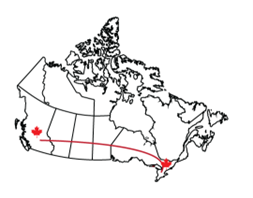
The Canada Health Act (CHA) is the legislation guiding publicly funded health care in Canada. The aim of the CHA is to ensure equitable access to healthcare across the country without incurring any additional costs for services (Government of Canada, 2023). Each province within Canada must meet the criteria and conditions set out in the Act to secure Federal funding. This does not equate to each Province functioning in the same manner.
This week, Kethra Stewart, a fellow MHST 601 student and I are partnering to examine the levels of influence with respect to our individual provinces. In my recent blog post applying the Social Ecological framework to the COVID-19 pandemic in long-term care in Ontario, she touched on the Community level of influence for the Province of Ontario. While the COVID-19 pandemic affected all of Canada, specific populations saw a far greater impact such as seniors, essential workers, and those living with disabilities. The COVID-19 pandemic worsened these impacts, but the inequities across this group existed well before the global pandemic hit.
In the Chief Public Health Officer’s Report on the state of Public Health in Canada (2020), the first COVID-19 pandemic in LTC was declared on March 7, 2020, in British Columbia while the largest outbreak in a congregate living setting was seen about a month later in Ontario with 164 cases (Chief Public Health Officer, 2020).
Narrowing in on the Community level in the framework, one can examine how these impacted residents in long-term care. Provincial Public Health agencies in Ontario have no accountability or oversight for long-term care. The role Public Health plays in long-term care in Ontario can be broken down into three categories – guidance, outbreak management and vaccinations. Public Health agencies in Ontario developed and enforced local mandates when it came to testing, isolation requirements, visiting guidelines, outbreak management strategies and distribution of vaccines once available for delivery. This meant that in Ontario, two cities located geographically close to one another may have entirely different regulations regarding protecting the public during the Covid 19 pandemic.
In British Columbia, there are five different regional districts, and each section is managed by different health authorities throughout the region of B.C. for governing health (Government of B.C, 2021). The Regional Health Authorities are Fraser Health, Interior Health, Island Health, Northern Health, and Vancouver Coastal Health (Government of B.C, 2021).
The community that I belong to is Interior Health, British Columbia because it is in my district where I live, south of B.C. There is one general hospital and a few urgent care medical clinics that patients can walk in without an appointment. Any pharmacy at most stores has a walk-in policy for vaccinations for flu and Covid19 (British Columbia Pharmacy Association, 2023). Each community follows the health authority in accordance with the public health policies as directed by the Health Minister of B.C. In order to work in the Interior Health, the Provincial Public Health order released a mandatory Covid-19 vaccination policy on October 14, 2021 (Interior Health, 2023). When the public health officer lifted the province-wide restrictions on March 11, 2022, there were still some restrictions that are mandatory such as proof of vaccination is not required to enter Canada though must be shown in long-term care centres but masks are still required in all clinical and health-care settings (Interior Health, 2023). Each organization in the community has a website that has information on Covid19 regarding facilities, employment opportunities, prevention and self-care, vaccination and booster information regarding Covid19 and other commonly asked questions.
Works Cited
British Columbia Pharmacy Association. (2023). 2022 Flu Vaccines in B.C. Pharmacies. https://www.bcpharmacy.ca/flu
Chief Public Health Officer. (2020). From Risk to Resilience: An Equity Approach to COVID-19. Ottawa: Public Health Agency of Canada. Retrieved from https://www.canada.ca/content/dam/phac-aspc/documents/corporate/publications/chief-public-health-officer-reports-state-public-health-canada/from-risk-resilience-equity-approach-covid-19/cpho-covid-report-eng.pdf
Government of B.C.(2021 June 09). Regional Health Authorities. British Columbia.
Government of Canada. (2023, January 29). Government of Canada. Retrieved from Canada Health Act: https://www.canada.ca/en/health-canada/services/health-care-system/canada-health-care-system-medicare/canada-health-act.html
Interior Health (2023). COVID19.


Comments